Thursday, 31 October 2013

Burn, Bury Or Scorch? Why Destroying Syria's Chemical Weapons Is Hard

Workers in protective suits hold dummy munition during a demonstration in a chemical weapons disposal facility in Muenster, Germany, on Oct. 30.

Workers in protective suits hold dummy munition during a demonstration in a chemical weapons disposal facility in Muenster, Germany, on Oct. 30.

Philipp Guelland/AFP/Getty Images

The Syrian government appears on track to make a Nov. 1 deadline to destroy its equipment for making and filling chemical weapons. But the destruction of the chemicals themselves — more than 1,000 tons of toxic ingredients — is going to be a far more daunting task.

The problem is that it's just not as easy to destroy chemical weapons as it used to be. At the end of World War II, every major world power with chemical weapons loaded them onto ships and barges and dumped them out at sea.

"The rough guestimate is [that] probably 300,000 tons or more have been dumped in every ocean of the world, except the Antarctic," says Paul Walker, director of Environmental Security and Sustainability with Green Cross International, an environmental group that tracks the impacts of weapons disposal.

The thinking at the time was that the deep ocean would be a safe place. Turns out it's not. Drums can leak dangerous toxins like mustard agents. In the years since, dumped compounds from chemical weapons have burned beachgoers and killed fishermen. Burying the weapons created just as many problems on land.

So in the late 1980s, when the U.S. and Russia decided to get rid of their huge Cold War-era caches, they tried something else: incineration. But it wasn't as straightforward as you might think, Walker says: "When you burn something, it doesn't just disappear, you know — it's physically impossible for everything to just disappear."

Incinerators had to be custom-built, along with chemical scrubbers that would clean the toxic exhaust. It took decades, and cost billions of dollars.

Things moved more quickly in Iraq after the 1991 Gulf War. The allies had to dispose of thousands of tons of Saddam Hussein's chemical agents. Most of it was done by incineration at a custom-built facility. But some of the munitions were too fragile, or had been damaged during the allied air attacks.

Several 122-mm rockets filled with the nerve gas sarin posed a particular problem. They couldn't be safely moved or handled, says Ron Manley, the chemist who oversaw the destruction. "Therefore the only way to destroy them was [this]: We created a fuel-air explosion and these rockets were destroyed in the fuel-air explosion."

After the first Gulf War with Iraq, a U.N. team blew up rockets that had been filled with sarin.

After the first Gulf War with Iraq, a U.N. team blew up rockets that had been filled with sarin.

Getty Images

In other words, they blew them up. But environmentalist Walker says this isn't an option in 2013.

"All open burn and open detonation [disposals] now [are] prohibited under the Chemical Weapons Convention," he says. "Ocean dumping is prohibited. Burial is prohibited."

It would take too long to set up an incinerator or other equipment in Syria, so today, the U.S. hopes that the agents can be moved out of the country.

"My hope is that much of this material will be moved as rapidly as possible into one location — hopefully on a ship — and removed from the region," Secretary of State John Kerry told NPR's Michele Kelemen in an interview earlier this month.

Experts agree it can be done. Virtually all of Syria's chemicals are ingredients, not weapons. That means they're toxic, but safer to transport. And there's a new technique for disposal. It's called hydrolysis, and it basically involves breaking the chemicals down, using hot water and other chemicals like bleach. The waste liquid from hydrolysis still needs to be treated but is a lot less dangerous.

The bottom line is that, after decades of practice, the disposal of chemical weapons can be done safely, says Walker. "It's done in Europe all the time, [and] in many ways — in France, in Belgium and Germany, in Italy," he says.

The key will be finding a country willing to accept chemicals from Syria. With environmental regulations these days, diplomacy — not technology — will be the hard part. Norway already has declined a U.S. invitation to take the stuff, in part due to its local environmental regulations. France, Belgium and Albania, which destroyed its own chemical stocks in 2007, are thought to still be under consideration.

The international community would like to see Syria's weapons destroyed by mid-2014. Given the challenges of finding a host country, that's "a very optimistic target," says Manley. Walker adds that the destruction methods will have to comply with environmental law, which could lengthen the process.

Still, he says it is critical that a host nation be found soon: "We can't just put it on a ship," Walker says, "and have it wander the Mediterranean for the indefinite future."

View the original article here

How Much Water Actually Goes Into Making A Bottle Of Water?

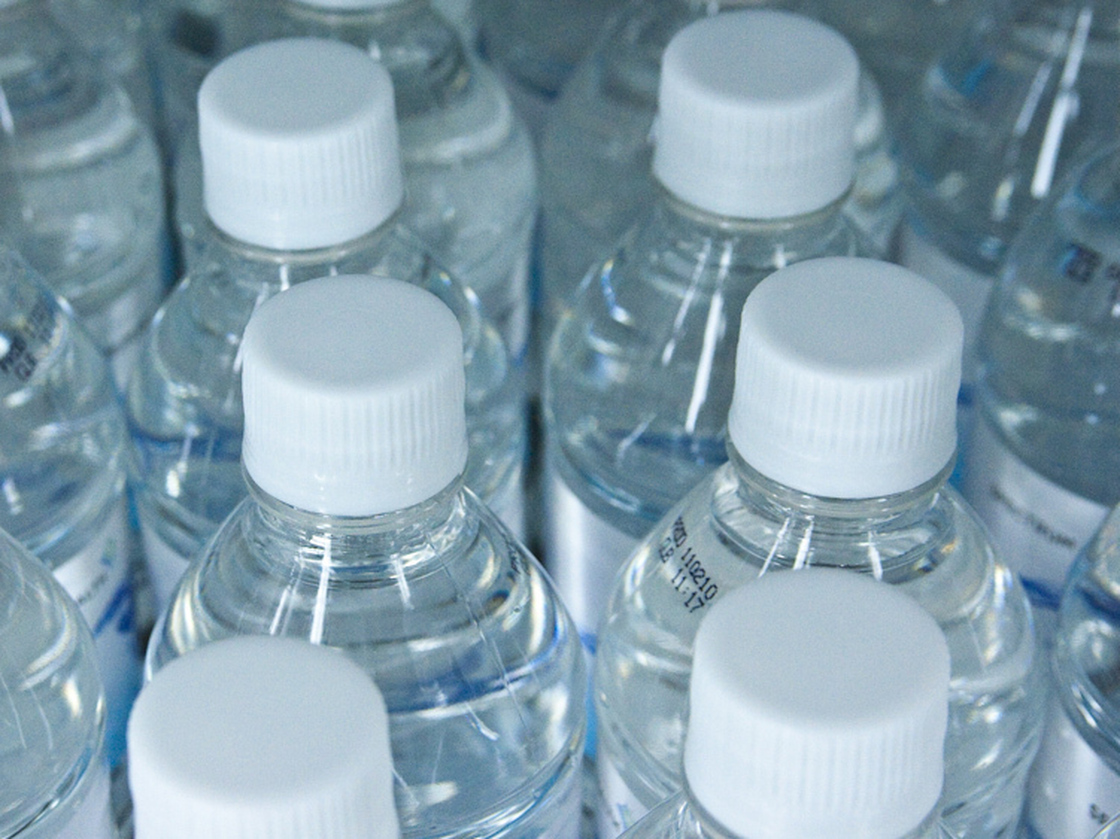
The amount of water to make the bottle could be up to six or seven times what's inside the bottle, according to the Water Footprint Network.

Steven Depolo/Flickr The amount of water to make the bottle could be up to six or seven times what's inside the bottle, according to the Water Footprint Network. The amount of water to make the bottle could be up to six or seven times what's inside the bottle, according to the Water Footprint Network.

Steven Depolo/Flickr

Environmental activists have long claimed that bottled water is wasteful. Usually, they point to the roughly 50 billion (mostly plastic) bottles we throw away every year.

The International Bottled Water Association, ever sensitive to criticism that it's wasting precious resources, has commissioned its first ever study to figure out how much water goes into producing one liter. The results, released this month, show that for North American companies, it takes 1.39 liters to make one liter of water.

That's less than the global averages of a liter of soda, which requires 2.02 liters of water. A liter of beer, meanwhile, needs 4 liters of water, wine demands 4.74 liters. Hard alcohol, it turns out, is the greediest, guzzling 34.55 liters of water for every liter.

This, the bottled water industry says, is evidence that its product isn't so bad. "Bottled water products are extremely efficient in terms of water use compared to some other packaged beverages," says Chris Hogan, spokesman for the International Bottled Water Association.

But water activists say the IBWA study highlights a problem throughout the beverage industry: Few companies take the whole water-use picture into account when calculating their water use. Just as companies are beginning to calculate their carbon footprint, they also need to analyze their water footprints to find opportunities for conservation.

Bottled water companies (along with many other beverage companies) should include the water in their supply chain, says Ertug Ercin with the Water Footprint Network. Ercin says a true water footprint includes all freshwater used in production, including the water used for packaging.

"Packaging makes a significant footprint," he says, adding that three liters of water might be used to make a half-liter bottle. In other words, the amount of water going into making the bottle could be up to six or seven times what's inside the bottle.

Drilling for oil to make plastic, Ercin says, uses a substantial amount of groundwater. And you need water to make the paper, too, he adds.

Still, Ercin notes, bottled water packaging uses far less water than soda, which needs extra water to grow sugar and make dyes.

Hogan says that one reason why the IBWA didnt look at these issues is that it's hard to know where to stop. "You could extrapolate that ad infinitum," he says.

Hogan says some companies say they don't think they can get any more efficient, but they're trying. "Water," Hogan says," is the lifeblood of the industry and they want to be as efficient as possible."


View the original article here

In Sandy's Wake, Flood Zones And Insurance Rates Re-Examined

Neighbors in the Rockaway section of Queens, N.Y., survey homes and businesses destroyed by Superstorm Sandy on Oct. 30, 2012. Hide caption Neighbors in the Rockaway section of Queens, N.Y., survey homes and businesses destroyed by Superstorm Sandy on Oct. 30, 2012. A resident traverses flooded streets as cleanup operations begin in Hoboken, N.J. The storm surge triggered deep flooding in low-lying neighborhoods. Hide caption A resident traverses flooded streets as cleanup operations begin in Hoboken, N.J. The storm surge triggered deep flooding in low-lying neighborhoods. Jackie Hoey inspects the first floor of her Long Beach, N.Y., home, which experienced heavy flooding. Hide caption Jackie Hoey inspects the first floor of her Long Beach, N.Y., home, which experienced heavy flooding. In the Ocean Breeze area of Staten Island, water continued to flood neighborhoods on Nov. 1, 2012. Most homes in the seaside community were inundated by the ocean surge caused by Sandy. Hide caption In the Ocean Breeze area of Staten Island, water continued to flood neighborhoods on Nov. 1, 2012. Most homes in the seaside community were inundated by the ocean surge caused by Sandy. Old photographs are laid out on a car hood to dry after being removed from a flooded home in Seaside Heights, N.J. At the time, New Jersey Gov. Chris Christie estimated that Superstorm Sandy had cost his state $29.4 billion in damage and other economic losses. Hide caption Old photographs are laid out on a car hood to dry after being removed from a flooded home in Seaside Heights, N.J. At the time, New Jersey Gov. Chris Christie estimated that Superstorm Sandy had cost his state $29.4 billion in damage and other economic losses. Sand marks the floodwater line on the side of a house in Long Beach, N.Y. Hide caption Sand marks the floodwater line on the side of a house in Long Beach, N.Y. Barbara Young tosses sand out her front door in Long Beach, N.Y. The storm caused massive flooding across much of the Eastern Seaboard. Hide caption Barbara Young tosses sand out her front door in Long Beach, N.Y. The storm caused massive flooding across much of the Eastern Seaboard. An emergency responder helps evacuate two people with a boat after their neighborhood in Little Ferry, N.J., was flooded. Hide caption An emergency responder helps evacuate two people with a boat after their neighborhood in Little Ferry, N.J., was flooded. In one Rockaway neighborhood the historic boardwalk washed away during the storm. Hide caption In one Rockaway neighborhood the historic boardwalk washed away during the storm.
When Sandy blew into East Coast communities a year ago, it was flooding that did the most damage.

That's in part because the average sea level has risen over the past century — about a foot along the mid-Atlantic coast. That made it easier for the storm to push the ocean onto the land.

And scientists say there will be many more Sandy-style storms — that is, torrential rain and wind that create heavy coastal flooding — and they'll be more frequent than in the past. But preparing people for that means changing the way they live, and that's proving politically difficult.

Sandy, in fact, wasn't such a powerful hurricane — "only" a Category 1 as it approached the shore. But a few coincidences made it freakish. Sandy hit the coastline right at high tide. It hit straight on, at a 90-degree angle. And the storm covered an enormous area.

All that happening at once is pretty unusual. But William Sweet, an oceanographer with the National Oceanic and Atmospheric Administration, says there's one thing that will be part of every new Atlantic coast storm — a higher sea level.

"Sea level is changing and it is going to keep changing regardless of who or what is causing it," Sweet says. "And the impacts are going to become more and more frequent and severe and we're going to have to deal with it."

Sweet and his NOAA colleagues agree with the majority of ocean scientists — that if climate continues to warm, average sea level will continue to rise by as much as 2 feet more by 2050. That's because a warmer ocean expands in volume. Also, landlocked snow and ice will melt into the ocean. Sea level rise is higher on average along the Eastern Seaboard than most parts of the world because of wind and ocean circulation patterns in the Atlantic.

And a rising ocean means that in the future, garden-variety storms will create the kind of flooding that big storms did in the past. NOAA says the type of storm you see only once a century or so now could hit every few decades by 2050 — and every few years if sea level rises as much as some computer models predict.

"Storms of lesser magnitude and storm surges that weren't as high as Sandy will have more and more importance in terms of the way that we live our lives," Sweet says.

One thing certain to change is the way people insure property against flooding. The federal National Flood Insurance Program requires most businesses and homeowners in high-risk flood zones to buy flood insurance. The Federal Emergency Management Agency administers the program and is now remapping those flood zones. And the new zones are a lot bigger.

Robert Moore, who studies flood policy for the Natural Resources Defense Council, says New York City formerly had about 35,000 buildings sitting in flood zones. That number has now doubled. "The new maps that were made in the wake of Hurricane Sandy show a much larger flood plain that encompasses about 67,000 buildings," Moore says. The increase is due to changes in sea level up to now, and to changes in the built environment that shift the way runoff moves.

FEMA, in fact, expects that the increase in flood risk areas and the number of people who live in them will continue. And that's without factoring in computer model predictions about the rise of sea levels in the future.

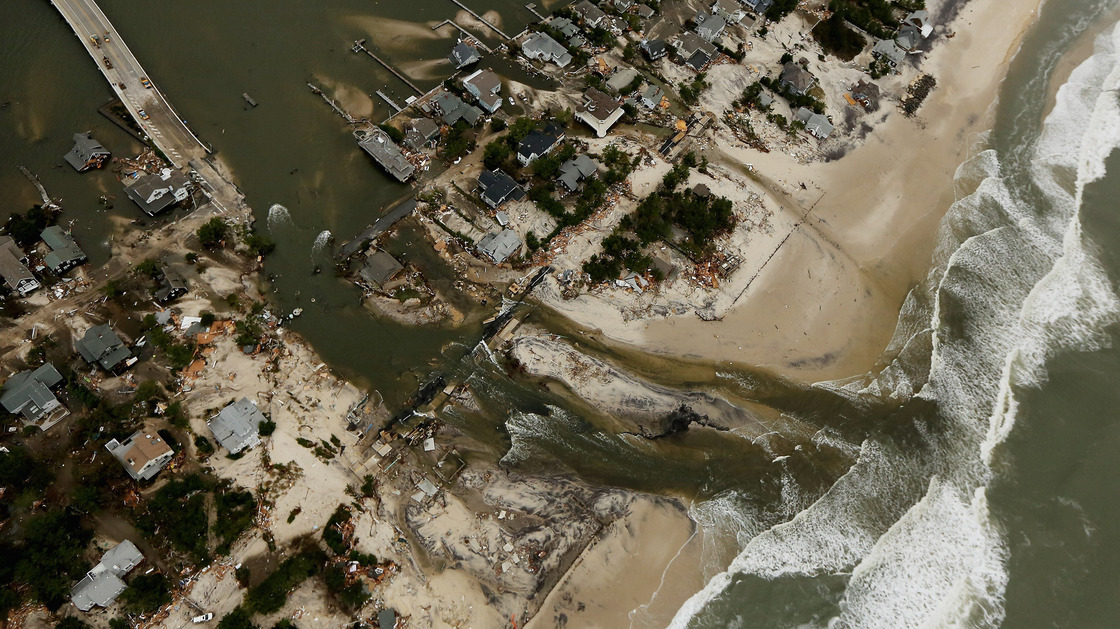
One Year Ago: Homes in Mantoloking, N.J., sit in ruin at the end of a bridge that was wrecked by flooding from Superstorm Sandy.

Mario Tama/Getty Images One Year Ago: Homes in Mantoloking, N.J., sit in ruin at the end of a bridge that was wrecked by flooding from Superstorm Sandy. One Year Ago: Homes in Mantoloking, N.J., sit in ruin at the end of a bridge that was wrecked by flooding from Superstorm Sandy.

Mario Tama/Getty Images

So, clearly more people are going to have to buy flood insurance. And insurance will cost more. That's because of a 2012 law that radically changes the flood insurance program. The law eliminates subsidies that have kept the premium rates for such policies artificially low for decades. Moore says that in some places, one-third of flood insurance policyholders have been getting subsidies.

"We've been subsidizing people to live in some of the riskiest parts of the country," Moore says, "and that is one of the reasons the national flood insurance program is so deeply in debt." Once FEMA pays off damages from Sandy, the agency will be $25 billion in the red.

Charging more for flood insurance would help mitigate that loss. But it's also a bitter pill for many. "There's a lot of pushback," Moore says. "People obviously have a little bit of sticker shock."

There's been so much sticker shock that the law passed last year (known as the Biggert-Waters Flood Insurance Reform Act, after its main congressional sponsors) is already in jeopardy.

This week, several members of Congress are proposing a bill to delay the insurance reforms called for in the Biggert-Waters act for as much as four years. Two other bills that would soften effects of the increased cost are in play as well.

New Jersey Democratic Sen. Robert Menendez calls FEMA's new flood maps and insurance rates "a man-made disaster."

"Many homeowners will be forced to pay premiums that are several times higher than the current rate they pay," Menendez says.

Now, raising premiums was exactly what last year's law was expected to do. So apparently the new debate will be: How do politicians bail out FEMA without raising the rates of the people who vote them in — or out — of office?


View the original article here

Putting On Einstein's Glasses

Whenever you look at the teeming, rich and oh-so-various world, if you've got the right eyes, if you've got the eyes of a mathematician, you will find patterns — simple, elegant forms hiding in everything you see. Those patterns explain why sugar dissolves in a cup of coffee, why clouds release rain, why a heavy plane can climb into the sky.

Non-mathematicians miss all this. We see the flurry of what's happening, not the tight logic underneath. But now comes this minute-and-a-half little video — a cheat sheet for math-challenged folks like me. It shows us what it's like to look around as if we were Galileo or Einstein or that kid who always raised his hand first in math class ... This is what they get to see ...

Thanks to Aatish Bhatia for sending this my way.


View the original article here

Why Are Kids Who Get Less Candy Happier On Halloween?

Kids might be more satisfied if they get one, good treat instead of one good treat and one lesser treat.

Kids might be more satisfied if they get one, good treat instead of one good treat and one lesser treat.

iStockphoto

What makes trick-or-treaters happy is candy. And more candy is better, right?

Well, it turns that that might not actually be the case. A few years ago researchers did a study on Halloween night where some trick-or-treaters were given a candy bar and others were given the candy bar and a piece of bubble gum.

Now in any rational universe, you would imagine that the kids who got the candy bar and the bubble gum would be happier than the kids who got just the candy bar. George Wolford is a psychologist at Dartmouth College. Along with his fellow researchers, Amy Doe and Alexander Rupert, he found something quite different.

"Those children that got both the full-sized candy bar and the bubble gum second-rated how delighted they were to get these treats lower than those people that got the candy bar only," says Wolford.

To understand what actually is going on we have to go back to the crib, to an earlier study done by Daniel Kahneman at Princeton University, who won the Noble Prize in economics. Wolford calls this one of his favorite studies in all of psychology.

Kahneman recruited a bunch of doctors to conduct a study among patients getting colonoscopies. Some of the patients got the regular colonoscopy – an uncomfortable, unpleasant procedure. And the others got the same procedure but at the end of it, the doctors didn't remove the tube from the patient's bodies. They actually left the tube in there a little while longer.

Now again, in any rational world, you would imagine that the patients that got the colonoscopy with the extra discomfort would rate their overall experience as being more painful and more unpleasant. But Kahneman found out that this was actually not the case. The patients who got the extra discomfort actually thought the colonoscopy as a whole went better and they were more likely to show up for follow-up treatment.

It actually comes down to the order in which these things happen. And that's the connection with the Halloween candy study. With the Halloween candy study, the kids got the great treat first and then a lesser treat afterward.

With the colonoscopies, they got the unpleasant procedure first and then they got something slightly less unpleasant afterward. And it turns out that when we think about experiences, we don't think about the experience as a whole — we are significantly biased by how the experience ends.

So if we have a great experience that starts to go downhill, we rate the overall experience as being less good. Whereas if something starts out terribly and then starts to get better toward the end, we rate the overall experience a little bit better. Wolford actually has a theory to explain this.

"If you're in a painful experience and it's getting better, then there's a sense in which things are improving," he says. "So what you're judging is the trajectory. With positive goods, if I'm going from a nice treat to a lesser treat, the trajectory is going the wrong way."

So if you get the lesser treat first and the nicer treat second, you're likely to be very happy, but if you get the nice treat first and the lesser one second, you're likely to be more dissatisfied with the overall experience.


View the original article here

Are the Miami Dolphins for Real? Let's Not Be Hasty


View the original article here

Denver Broncos Overrated, New Orleans Saints Underrated

Jadeveon Clowney

The Denver Broncos have been world-beaters when they play the league's downtrodden dregs, but when they finally play a team that's moderately competitive they barely hang on for a win, slipping by the Cowboys 51-48.

The Saints, on the other hand, were 4-0 heading into the hostile confines of Chicago's Soldier Field, where they whipped the Bears and a pretty good defense, 26-18.

The Broncos have an all-world offense, with Peyton Manning putting up ridiculous numbers. But, Cowboys quarterback Tony Romo shreds their defense with over 500 yards in the air.

And as the old ball coaches say, offense wins in the regular season, defense wins in the playoffs.

At first, I thought the Saints were winning on emotion and adrenaline. This is a team that was rudderless last year because their coach Sean Payton was at home, watching the games on TV due to the infamous "Bountygate" suspension.

They all came together in training camp with a rough edge, wanting a little payback.

But, after handling the Bears on the road, it looks like they're making a good case for legitimacy.

These are only two teams who have proven themselves under- and over-rated at this point in the season. Here are some others.

- Getty Images


View the original article here