Showing posts with label Space. Show all posts

Thursday, 7 November 2013

Olympic Torch Relay Headed To Space

Flight Engineer Koichi Wakata of the Japan Aerospace Exploration Agency, left, Soyuz Commander Mikhail Tyurin of the Russian space agency Roscosmos, and Flight Engineer Rick Mastracchio of NASA, hold the Olympic torch that will be flown with them to the International Space Station, during a press conference on Wednesday.

Flight Engineer Koichi Wakata of the Japan Aerospace Exploration Agency, left, Soyuz Commander Mikhail Tyurin of the Russian space agency Roscosmos, and Flight Engineer Rick Mastracchio of NASA, hold the Olympic torch that will be flown with them to the International Space Station, during a press conference on Wednesday.

Bill Ingalls/NASA

The Soyuz rocket that launched from Kazakhstan on Wednesday night has some special cargo on board. In addition to three crew members from Japan, Russia and the U.S., the International Space Station-bound probe is carrying an Olympic torch.

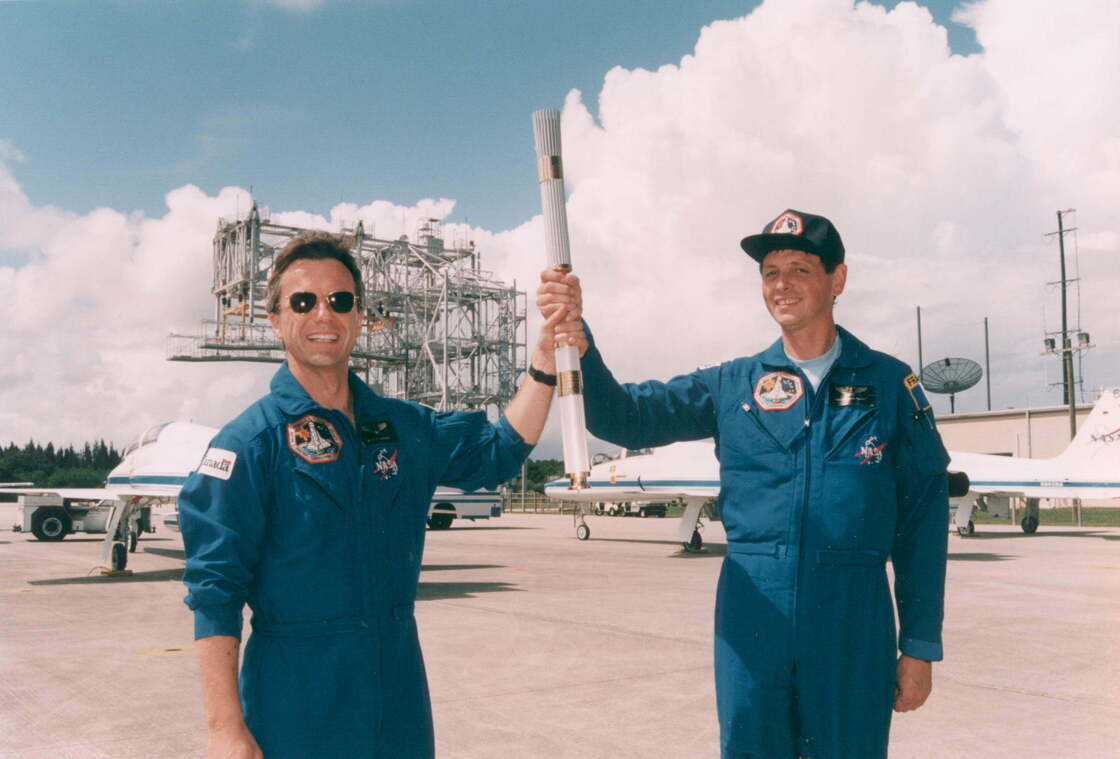
Payload specialists Robert Brenton Thirsk, left, and Jean-Jaques Favier hold the Olympic torch they brought to space aboard Space Shuttle Columbia in 1996.

NASA Payload specialists Robert Brenton Thirsk, left, and Jean-Jaques Favier hold the Olympic torch they brought to space aboard Space Shuttle Columbia in 1996. Payload specialists Robert Brenton Thirsk, left, and Jean-Jaques Favier hold the Olympic torch they brought to space aboard Space Shuttle Columbia in 1996.

NASA

As we reported in June, the torch won't be lit — open flame inside the spacecrafts would be dangerous and consume precious oxygen. But Russian cosmonauts Oleg Kotov and Sergey Ryazanskiy will carry the torch outside the station as part of a six-hour spacewalk on Nov. 9.

The Olympic torch will return to Earth on Nov. 10, along with three astronauts currently on board the ISS: Karen Nyberg, Luca Parmitano and Fyodor Yurchikhin.

This year's torch relay is the longest in Olympic history. The 123-day journey, which crisscrosses Russia, will cover more than 40,000 miles and involve more than 14,000 torchbearers.

And this trip isn't the first time an Olympic torch has left the planet — one flew with Space Shuttle Columbia in 1996 before the Atlanta games, and another in 2000 on Space Shuttle Atlantis, before the Sydney Olympics.


View the original article here

Space Agencies Of The World, Unite: The U.N.'s Asteroid Defense Plan

This mosaic image from NASA's Dawn spacecraft, captured between 2011 to 2012, shows the giant asteroid Vesta. The mountain at the south pole, seen at the bottom of the image, is more than twice the height of Mount Everest.

This mosaic image from NASA's Dawn spacecraft, captured between 2011 to 2012, shows the giant asteroid Vesta. The mountain at the south pole, seen at the bottom of the image, is more than twice the height of Mount Everest.

NASA

The United Nations General Assembly may approve a plan soon for the world's space agencies to defend the Earth against asteroids.

The plan, introduced last week, is expected to be adopted by the General Assembly in December. It would do two things: create an International Asteroid Warning Network so countries can share what they know about asteroids; and spin up a group of scientists from several countries' space agencies to look for smaller asteroids, as well as make plans to divert them away from the Earth.

The problem here isn't a large asteroid. NASA has already found more than 90 percent of the comets and asteroids larger than 1 kilometer, or 0.6 miles, across — those are the ones big enough to do global damage.

The concern is for the smaller meteoroids — ones that are more than 450 feet across. These can still get through the Earth's atmosphere and rain down on the planet. Although most of the Earth is covered by oceans, an asteroid of this size could destroy several states or an entire city if it lands in the wrong spot.

An international group, formed from discussions at the U.N., would test a strategy to deflect an incoming asteroid by using "a fleet of robot spacecraft to slam into the asteroids," says veteran NASA astronaut Tom Jones. These kamikaze robots would change the direction of the incoming asteroid so it doesn't crash into the Earth.

NASA tried something similar with its 2005 Deep Impact mission, which slammed into a comet to see how the inside differs from the outside.

Jones estimates the cost of a deflection plan would be comparable to the price tag for the Mars Curiosity Rover, which cost $2.5 billion. By working with other space agencies, this cosmic insurance policy would spread this cost around. The plan is for the space agencies to work together, like they have done on the International Space Station, except this project would come with the blessing of the U.N. and the global community.

Jones, who also chairs the Association of Space Explorers' committee on Near-Earth Objects, says the telescopes NASA currently has can't spot these small, but potentially deadly space rocks.

"Those telescopes are not sensitive enough to see distant, small, dark asteroids," Jones says. "The only time they see those is by accident when those asteroids drift past the Earth close by, then you can catch a few of them in your sights."

In 2005, Congress passed legislation asking NASA to find 90 percent of these small asteroids by 2020, but NASA is still working on that. The space agency recently called for the public's help in searching for them, and it brought back a retired spacecraft to spot them. To get closer to this goal, NASA needs special infrared telescopes in space, but the space agency doesn't have the money for them, says Lindley Johnson, program executive for NASA's Near-Earth Object Program, which tracks comets and asteroids in the Earth's neighborhood.

Johnson and Jones both say a plan from the U.N. would enhance what NASA is already doing.

"Here's the biggest of all natural disasters that we're talking about, and it's preventable," Jones says.

Earlier this year, a meteorite hit Chelyabinsk in Russia and injured 1,000 people. "If the people in Chelyabinsk had been warned a day beforehand," Jones says, "they could have been away from the windows or in shelters where almost nobody would have been hurt."

Getting several space agencies and their respective countries on board can also avoid trust problems, Jones says.

"Do you trust the Russians? Do you trust NASA to do a deflection all by itself?" he says. "If they make a mistake halfway through and an asteroid happens to land somewhere else than where we originally thought, who's to blame? We'd rather have that responsibility shared and sanctioned by the U.N. rather than a unilateral approach."

The U.N. member nations that are actively participating include the U.S., the U.K., the countries that are part of the European Space Agency, Russia, Japan, Nigeria and Mexico, says Sergio Camacho-Lara, director of the U.N. Office for Outer Space Affairs.

As the U.N. is the only universal forum for discussing international issues, Camacho-Lara says it is the best way to make sure the world's governments can start thinking about the threat from asteroids. As of now, the resolution is a draft that has been endorsed by several U.N. committees, but Camacho-Lara says in the past 50 years, only four resolutions have reached this point and not been adopted by the General Assembly.

"We will be finding, in the next five, 10 years, another half million or more [asteroids], so the magnitude of the problem is quite a bit larger than what we have right now," Camacho-Lara says. "But the asteroids are there, it's a question of finding them before they actually find us."


View the original article here

Monday, 28 October 2013

Netflix On The Moon? Broadband Makes It To Deep Space

NASA's Lunar Atmosphere and Dust Environment Explorer probe, seen in this artist's rendering, is orbiting the moon to gather detailed information about the lunar surface.

NASA's Lunar Atmosphere and Dust Environment Explorer probe, seen in this artist's rendering, is orbiting the moon to gather detailed information about the lunar surface.

Dana Berry/NASA

Here's a funny quirk of the modern age: It takes just seconds to pull up a bad sci-fi movie about invaders from the moon and watch it in HD. But actual communications between the Earth and moon are just as static-filled as they were back in the 1960s.

Until now. NASA says it's just gotten a lunar broadband connection up and running. The new connection is just a test, but it could allow scientists to collect more data from spacecraft and rovers. It could also allow astronauts to maintain good communications as they travel farther from Earth.

Communication in deep space hasn't changed a lot since NASA launched its earliest probes in the late 1950s. Everyone still uses giant radio dishes to talk to rovers on Mars or spacecraft orbiting Mercury. Radio is dependable, but here on Earth, we've moved on. Aside from NPR on your car radio, you probably get most of your news via broadband. And broadband sends data in pulses of laser light.

"Our Internet is completely powered by pulsed lasers that run through optical fibers in big cities," says Don Cornwell, project manager for the new communications system at NASA's Goddard Space Flight Center in Maryland.

Lasers are fast and can send huge amounts of data a long way. But doing it from space presents a problem: Ever tried to steady a laser pointer during a presentation?

"Try doing it over 400,000 kilometers," Cornwell says

That's just what Cornwell and his colleagues from the Massachusetts Institute of Technology's Lincoln Laboratory have done. They put a laser transmitter built at MIT aboard a probe called the Lunar and Atmospheric Dust Environment Explorer, which is currently orbiting the moon. Using some very precisely aimed telescopes on Earth, they've been able to send and receive data at broadband speeds.

"We're currently demonstrating 622 megabits per second of data transmission, from the moon down to the Earth," Cromwell says. That's already six times faster than the fastest radio communications, and the laser system could eventually be much faster still.

It's not perfect. For example, it won't work if it's cloudy on Earth. For that reason, Cromwell's team has built multiple ground stations in California, New Mexico and on the island of Tenerife in Spain. And the laser would have to be boosted in power to work over longer distances, like between the Earth and Mars.

But if it can be built, it will be a huge help to astronauts on deep-space missions. For example, a laser system could transmit HD video of equipment in need of fixing to engineers back on Earth, Cornwell says. Astronauts could also get their fill of really bad sci-fi.

Those missions are further off, but the unmanned probes of today would also benefit, says John Grotzinger, project scientist for the Curiosity Rover now exploring Mars. Like everyone else, Curiosity uses standard radio communications, and Grotzinger says it's holding the team back: "With this additional [laser] capability we would be less limited in terms of how much data we could both acquire and downlink to Earth," he told NPR in an e-mail. "That would be a really nice improvement."


View the original article here